
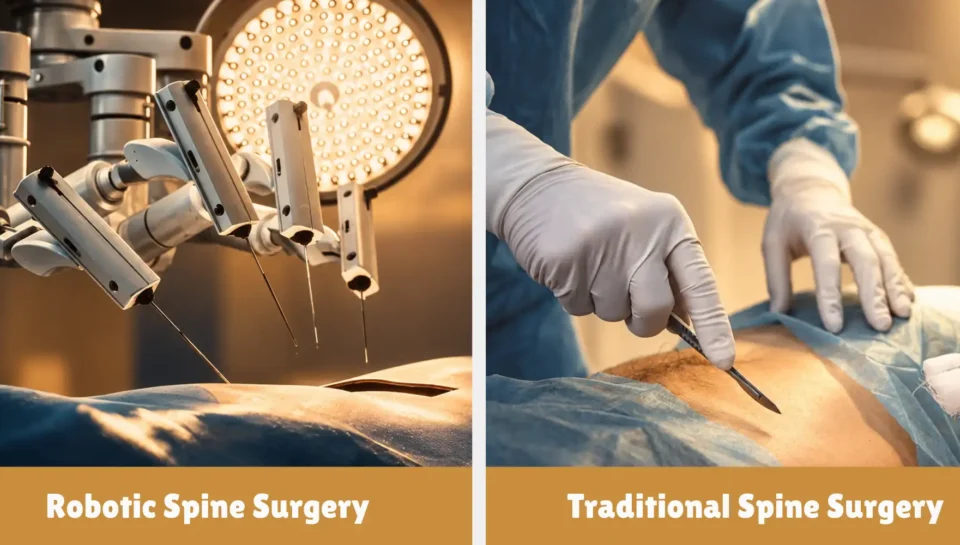

If you have been advised to consider spine surgery, it is reasonable to ask whether a robot-assisted procedure is safer or more effective than traditional surgery. The main difference is how certain steps are planned and guided, particularly the placement of screws used to stabilise the spine. A robot does not diagnose your condition, decide whether you need surgery or operate independently. An experienced surgeon remains responsible for the procedure and every important decision.
For patients comparing robotic vs traditional spine surgery, the most useful question is not simply which technology is newer. It is whether you need an operation at all, which operation addresses your problem and whether robotic guidance adds a meaningful advantage in your specific case.
Robotic vs Traditional Spine Surgery: A Quick Comparison
| Feature | Robot-assisted approach | Traditional approach |
| Who operates? | The surgeon; a robotic system assists with selected tasks. | The surgeon, using direct vision and standard instruments. |
| Planning | Often uses a 3D scan and computer-planned instrument paths. | Uses imaging and surgical landmarks; may also use computer navigation. |
| Screw placement | A robotic arm or guide helps align instruments to a planned trajectory. | Screws may be placed freehand, with X-ray guidance or with navigation. |
| Decompression | The surgeon still releases the compressed nerves when indicated. | The surgeon performs the same essential nerve-release step. |
| Recovery | Depends mainly on the operation, tissues affected and patient factors. | Depends on those same factors; an open or minimally invasive route may be used. |
| Main limitation | Extra imaging, set-up and technical complexity may be involved. | Accuracy relies on the chosen technique, anatomy, imaging and operator experience. |
What Does A Spine Surgery Robot Actually Do?
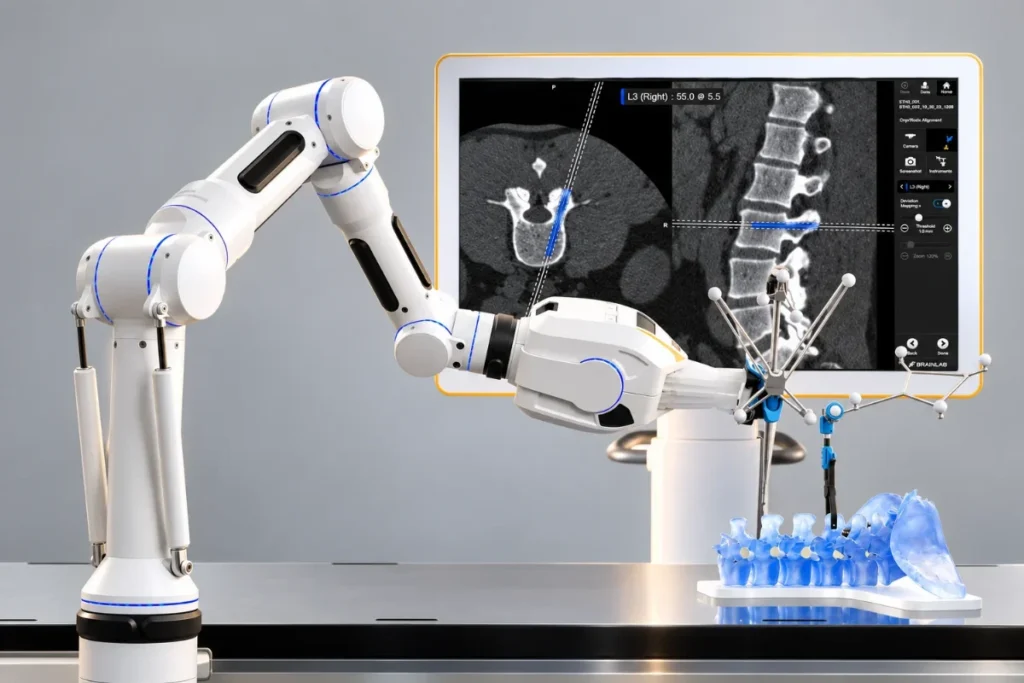
Most robot-assisted spinal systems are guidance platforms. Before or during the operation, detailed imaging is used to build a map of the relevant vertebrae. The surgeon plans where an instrument or screw should enter the bone, its direction and its depth. A robotic arm can then help position a guide along that path. The surgeon checks the anatomy, uses the instruments and can modify or abandon the plan if necessary.
This is particularly relevant to pedicle screws, which pass through a small bridge of bone into the vertebra and may be connected by rods. They are often used during spinal fusion or stabilisation surgery. They are not used in every spine operation. A straightforward decompression for a pinched nerve, for example, may require no screws and therefore offer little role for a screw-guidance robot.
The US Food and Drug Administration’s information on computer-assisted surgical systems emphasises that robotic devices operate under human control and that patients should discuss the alternatives, limitations and the surgeon’s training. Spine-specific robots differ from the multi-arm abdominal systems often shown in advertisements, so the exact equipment and task should be explained rather than assumed.
How Is Traditional Spine Surgery Performed?
‘Traditional’ is not one single technique. Some surgeons work through an open incision with direct exposure of the spine. Others use smaller incisions, a microscope, an endoscope, X-ray guidance or computer navigation. A conventional operation can therefore be highly precise and minimally invasive, even without a robot.
For spinal stenosis, the surgeon may remove bone or thickened ligament to make room for nerves. For instability, fusion may be considered to help selected bones heal together. The underlying purpose of either procedure is unchanged when robotic guidance is added. The American Association of Neurological Surgeons’ explanation of minimally invasive spine surgery distinguishes the size of the access route from the actual operation being performed.
Is Robotic Spine Surgery More Accurate?
Studies comparing methods of pedicle screw placement generally report better radiographic screw-position accuracy with robotic guidance than with unguided freehand placement. A 2024 systematic review found higher screw accuracy but no statistically clear difference in overall postoperative complications or operation time across the trials included. A newer evidence synthesis also supports an accuracy advantage, although the included studies differ in design and quality.
That distinction matters. A screw that is positioned more closely to the planned path is a technical result. It does not automatically mean less pain, faster nerve recovery, a higher fusion rate or a better long-term quality of life. Those patient outcomes depend on much more than one imaging measurement. Similarly, modern computer-assisted navigation is a separate comparison from conventional freehand techniques; a centre using navigation is not necessarily operating without sophisticated guidance.
There is also no guarantee that a more accurate average screw position makes an individual operation complication-free. Risks such as infection, bleeding, nerve injury, blood clots, anaesthetic complications and persistent symptoms can still occur, regardless of the method used.
Can Robotic Surgery Mean Smaller Incisions Or Less Blood Loss?
Robotic screw guidance may be combined with percutaneous, or through-the-skin, instrumentation. This allows screws to be inserted through smaller openings in selected cases. However, the robot itself does not make an operation minimally invasive. A skilled surgeon can use a minimally invasive approach without robotics, and some complex robot-assisted procedures still require an open exposure.
Certain studies suggest differences in blood loss, radiation exposure or hospital stay, but the findings are not consistent across every comparison. Radiation is especially difficult to summarise because it depends on whether preoperative CT, intraoperative 3D imaging and live X-rays are counted, and whether the outcome concerns the patient or theatre team. Ask about the imaging plan at the specific hospital rather than accepting a general claim of ‘less radiation’.
When Might A Robot Be Particularly Useful?
A surgeon may find image-guided robotic assistance helpful when accurate screw trajectories are technically demanding, such as in selected deformity corrections, complex fusion operations, revision surgery or anatomy altered by previous procedures. It may also support planned placement of multiple screws during a minimally invasive stabilisation procedure.
That does not mean a robot is necessary in all complex cases, or that any patient with back pain would benefit from it. A simple disc operation or a decompression that does not require fixation may be performed effectively using standard instruments or other image-guided techniques. The relevant comparison should be between realistic options for the same diagnosis, not between the most advanced-looking technologies.
Do The Scan Findings Mean I Need Spine Surgery?
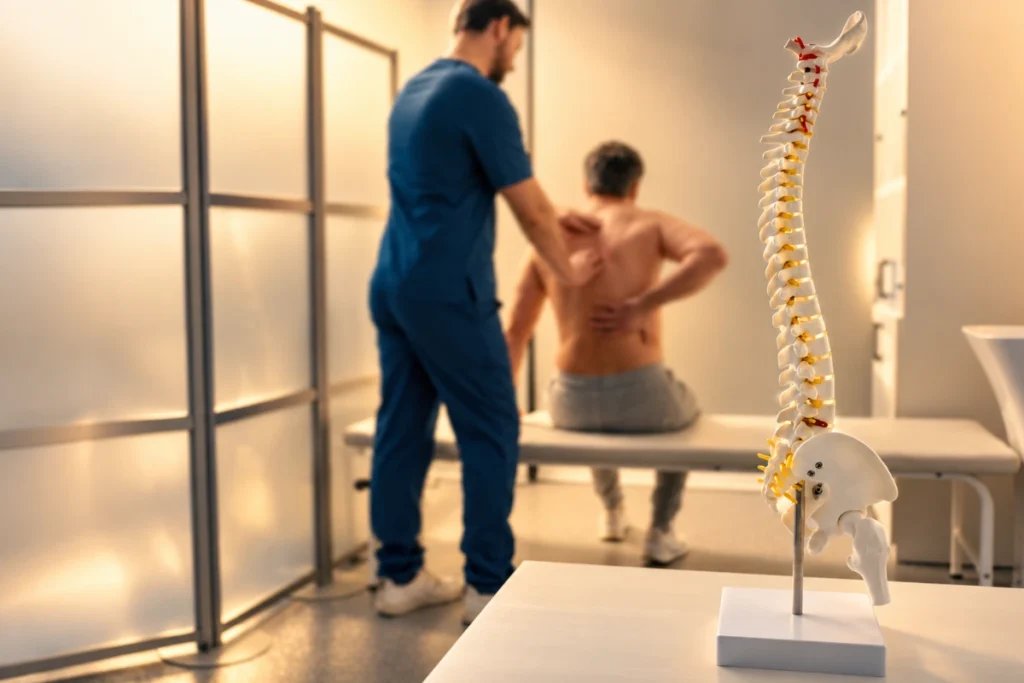
Not necessarily. Degenerative changes, disc bulges and narrowing can appear on an MRI even when they are not responsible for the patient’s main symptoms. The starting point is your history: where pain travels, what triggers it, whether walking or standing is limited, and whether there is genuine loss of strength or sensation. The examination then checks movement, neurological function and possible alternative explanations.
Imaging helps show the anatomy, but it must fit the clinical picture. The National Institute of Arthritis and Musculoskeletal and Skin Diseases describes a range of non-surgical treatments for spinal stenosis and notes that not everyone with persistent symptoms is a surgical candidate. Surgery is usually considered when there is a clear target for treatment and the expected benefit outweighs its risks.
What Is Usually Considered Before An Operation?
Depending on the diagnosis, non-surgical care may include maintaining tolerable activity, targeted physiotherapy, changes to lifting or prolonged standing, weight management where relevant and carefully chosen pain medicines. Injections may help some patients with radiating leg pain, although relief may be temporary and they do not reverse spinal wear or correct mechanical instability.
The decision also depends on the severity and duration of symptoms, work demands, previous treatment, other medical conditions and patient priorities. Progressive neurological weakness or emergency nerve symptoms require a different timetable from stable, intermittent pain. No patient should feel that choosing a newer technology is the same as choosing to have surgery.
Risks, Limitations And What Happens If The Plan Changes
Robot-assisted operations involve equipment registration, an imaging-to-patient match and planned instrument paths. Movement or an inaccurate registration can require repeat checks, adjustments or a switch to conventional guidance. Hardware can also fail. A surgeon must be prepared to continue safely without robotic assistance if that becomes necessary.
The major risks still relate to the operation itself: nerve or dural injury, infection, bleeding, blood clots, misplaced or loosened implants, failure of bone fusion where fusion is planned, ongoing pain and sometimes additional surgery. The likelihood depends on the procedure, health status and complexity. Robotic guidance does not eliminate the need for careful consent or postoperative follow-up.
How Long Does Recovery Take After Robotic Or Traditional Spine Surgery?
Recovery is determined more by what was done than by whether a robot was in the room. A limited decompression can have a different recovery plan from an instrumented fusion spanning several levels. Wound comfort, return to desk work, safe driving, strengthening and return to heavy labour are separate milestones. If fusion is performed, the biological process of bone healing continues long after the skin incision has healed.
Mobilisation and return to activity should be graded and individualised. Your surgeon may set restrictions because of the stability of the spine, bone quality or additional procedures. A smaller incision alone is not permission to return to lifting or sport early.
What Should I Ask My Surgeon Before Choosing A Technique?
Ask first: What exact diagnosis is causing my symptoms, and what would happen if I continued appropriate non-surgical care? Then ask whether the proposed operation is decompression, fusion or both; why screws are needed; what result is realistic for leg pain, back pain and walking ability; and what new risks are introduced by fusion.
If robotics is proposed, ask which part it will assist, how it compares with navigation or freehand placement in your case, how often the surgeon and team use the system and what the backup plan is. In Abu Dhabi, the Department of Health defines professional scope by the clinician’s licence, competence and granted clinical privileges. The hospital should confirm that the proposed equipment and procedure are available and appropriately authorised. US device guidance is informative but is not a statement of UAE approval or availability.
When Is A Spine Problem Urgent?
Seek emergency medical assessment for new difficulty passing urine, loss of bladder or bowel control, new numbness around the genitals or buttocks, or rapidly worsening leg weakness. These can indicate serious pressure on nerves controlling the lower body and must not be managed by waiting for a routine surgical consultation.
Frequently Asked Questions
1. Does the robot perform the operation by itself?
No. The surgeon controls the operation, interprets imaging, performs the necessary surgical steps and remains responsible for safety.
2. Is robotic spine surgery always minimally invasive?
No. Robotics can be combined with small incisions, but the approach depends on the procedure and anatomy. Traditional surgery can also be minimally invasive.
3. Does higher screw accuracy guarantee a better result?
No. Better screw positioning is a technical measure; pain relief, function, nerve recovery and fusion healing are separate outcomes.
4. Can spinal stenosis be treated without a robot?
Yes. Many patients are treated without surgery, and when decompression is needed it can often be carried out without robotic assistance.
5. Is robotic surgery safer than open surgery?
Not as a universal rule. The available evidence varies by procedure and outcome. The surgeon should compare like-for-like operations and explain individual risks.
6. Will I need a CT scan?
Some robotic systems use CT-based planning or intraoperative 3D imaging. Others use different workflows. Your team should explain the imaging and radiation involved.
7. Can an operation start robotically and finish conventionally?
Yes. The surgeon may change technique if anatomy, positioning or equipment makes another method safer.
8. Is fusion always required when robotic guidance is used?
No, but many current spinal robotic applications focus on instrumentation used during fusion. Whether fusion is needed is a separate clinical decision.
9. When could I return to work?
That depends on the procedure, neurological symptoms, recovery and physical demands of your job. Desk work and heavy manual work often have different timelines.
10. What if my MRI looks severe but my symptoms are manageable?
Severity on imaging alone does not decide treatment. A specialist should correlate the scan with function, examination and any signs of neurological deterioration.
Choosing The Operation Is Not Just The Technology
For Dr. Hassan Seif, Consultant Neurosurgeon and Spine Surgeon in Al Ain, the decision starts with identifying the problem that needs to be treated: compressed nerves, painful structural disease, genuine instability or a combination. Robotic guidance may be useful for selected instrumentation, but it should serve a carefully chosen operation rather than become the reason for surgery.
If symptoms persist, worsen or limit walking, sleep or everyday activity, a spine assessment can clarify what the clinical findings and imaging mean, what non-surgical options remain and whether any type of operation is justified.
Medical Disclaimer
This article provides general educational information and does not replace individual medical advice, diagnosis or treatment. Treatment suitability depends on the patient’s symptoms, examination findings, investigations, medical history and individual clinical circumstances. New bladder or bowel dysfunction, saddle numbness or rapidly worsening weakness requires emergency assessment.