

If walking makes your legs ache, feel heavy or go numb, and sitting or leaning forward helps, lumbar spinal stenosis is one possible explanation. But a scan showing a narrow spinal canal does not automatically mean you need an operation. Many people can manage symptoms with non-surgical treatment, and some people have narrowing on MRI without symptoms at all.
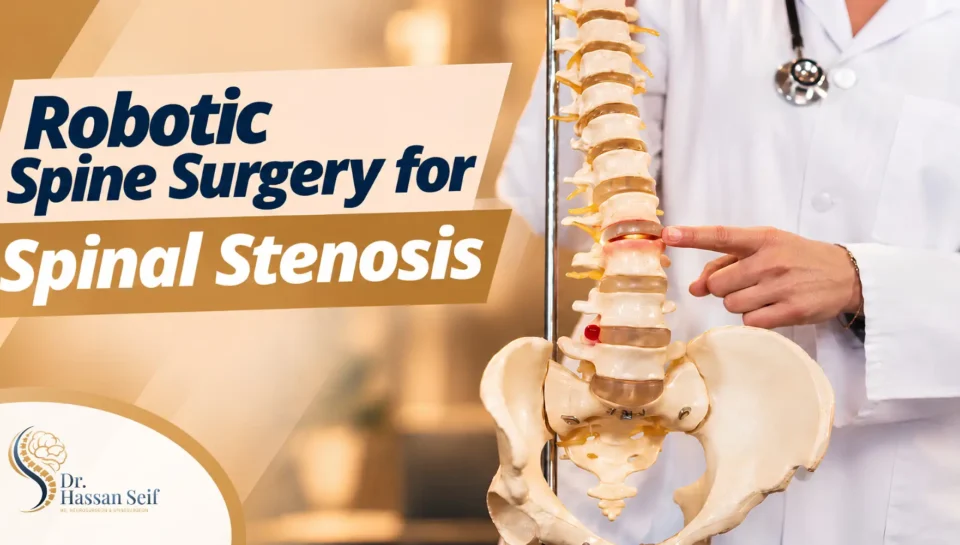
Robotic spine surgery for spinal stenosis is considered only in selected surgical cases, most often when stenosis is accompanied by a need for spinal fixation or fusion. The robot usually helps the surgeon plan and guide screw placement. It does not, by itself, remove the tissue pressing on the nerves. Whether decompression alone or decompression with stabilisation is appropriate must be decided first.
What Happens In Spinal Stenosis?
The spinal canal is a passage through the bones of the spine. In the lower back, it contains nerves that travel towards the legs. With age-related changes, joints can enlarge, ligaments can thicken and discs can bulge. These changes may reduce the room available to the nerves. Stenosis can affect the central canal, the side recess where a nerve travels or the opening where the nerve exits.
The usual symptom pattern is called neurogenic claudication: pain, tingling, fatigue or weakness in one or both legs brought on by standing or walking and often eased by sitting or bending forward. The American Association of Neurological Surgeons’ information on lumbar spinal stenosis describes this pattern. Some patients also have low back pain, but lower back pain alone is not enough to establish stenosis as the source.
Leg symptoms can arise from other conditions, including a hip problem, peripheral neuropathy or reduced blood supply to the legs. That is one reason a specialist asks what happens during walking, checks pulses and neurological function where appropriate, and does not rely only on a radiology report.
What Does Robotic Assistance Change In Stenosis Surgery?
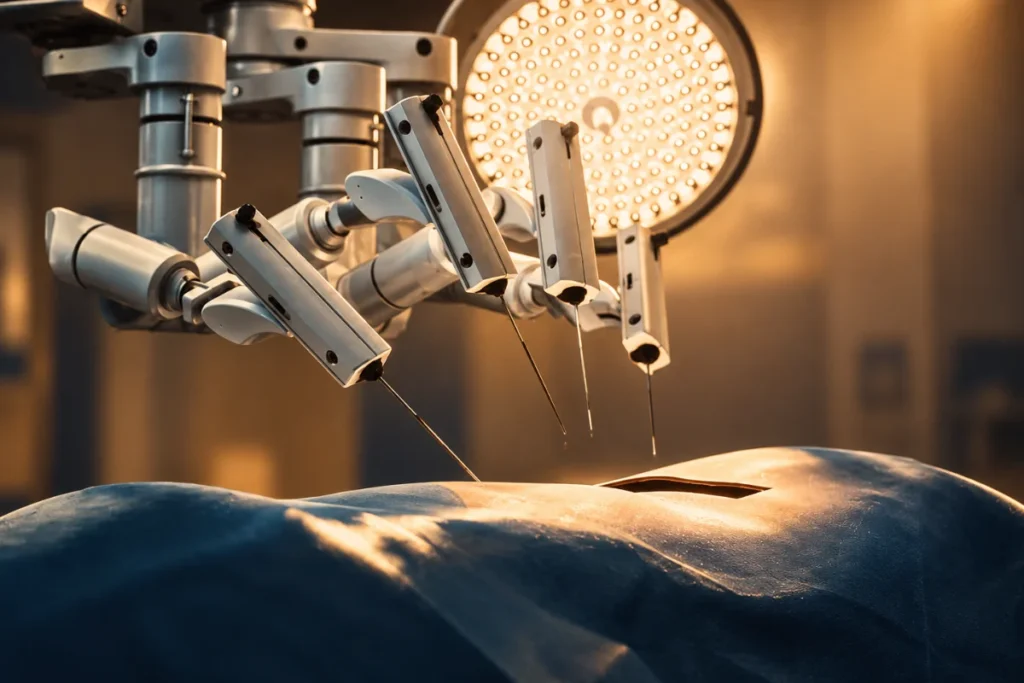
Spinal decompression is the operation that creates more room for a compressed nerve. Depending on the site of narrowing, the surgeon may remove part of the lamina, a thickened ligament or other tissue. A microscope or endoscope may assist this work. Robotic navigation, by contrast, is most commonly used to help position instruments and pedicle screws when fixation is required.
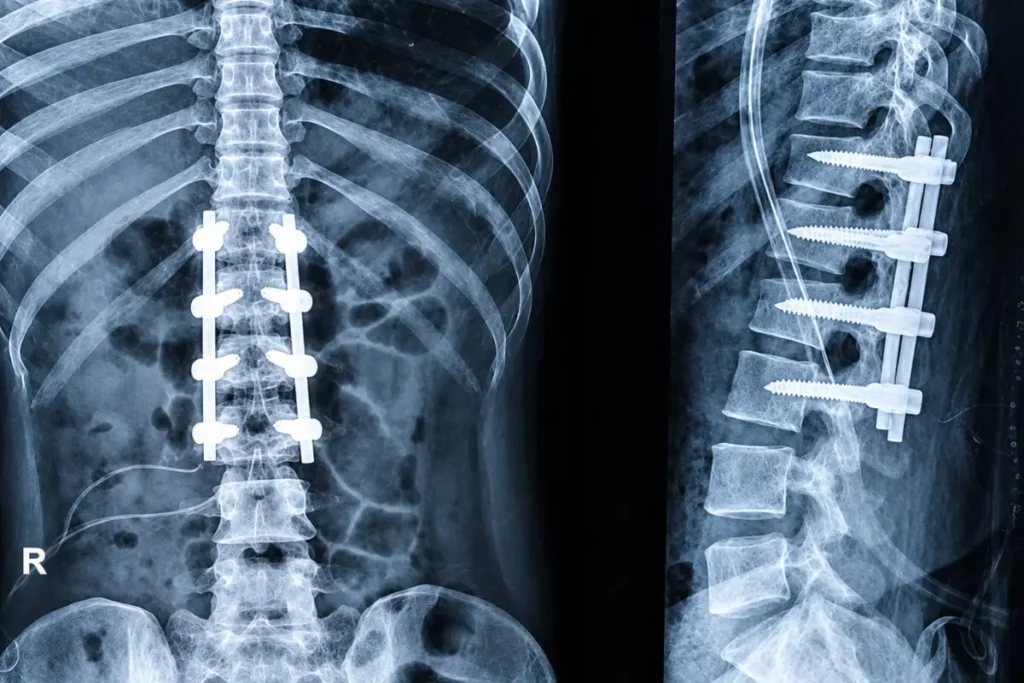
In a patient with stenosis plus a separate reason for fusion, such as clinically important instability or a particular deformity, the surgeon may combine decompression with screws, rods and bone graft. A robot can help guide the planned screw trajectories, but the surgeon still performs and supervises the operation. The FDA’s explanation of computer-assisted surgical systems makes clear that such systems do not operate autonomously.
This distinction prevents an understandable misunderstanding: a patient hearing ‘robotic stenosis surgery’ may imagine that the robot directly opens the spinal canal. In most current clinical workflows, the technology assists with guidance for instrumentation, not the decision to decompress or the nerve-release step itself. The precise role depends on the hospital’s system and surgical plan.
Who May Benefit From Considering Surgery For Lumbar Stenosis?
Surgery may be discussed when a patient’s leg pain, numbness or walking limitation remains substantial despite a reasonable course of suitable non-surgical care, or when clinically important neurological weakness is developing. The symptoms should be consistent with the location of compression on MRI or other imaging. The goal is usually to improve nerve-related leg symptoms and walking function, not to promise that every source of back pain will disappear.
Someone who can walk comfortably, sleep well and manage normal activities may not benefit enough from surgery to justify the risks, even if the MRI uses the word ‘severe’. Conversely, a patient with marked deterioration in walking or strength may require earlier assessment. The treatment selection reflects symptoms, examination findings, health and whether the anatomy can be treated surgically.
The question of whether a robot is appropriate comes after this decision. If screws are not needed, robotics may add little. If a complex stabilisation is justified, image-guided screw placement can be one of several reasonable techniques.
Does spinal stenosis always need a spinal fusion?
No. Many patients who need surgery for lumbar spinal stenosis can have decompression alone, without rods and screws. Fusion joins adjacent vertebrae with the aim of reducing problematic movement. It is a larger intervention and brings additional considerations, including blood loss, infection risk, failure of fusion, adjacent-level changes and a different recovery process.
Fusion may be considered when stenosis coexists with clinically relevant instability, certain deformities or circumstances in which adequate decompression would compromise stability. However, a low-grade degenerative spondylolisthesis, or small vertebral slip, does not automatically establish a need for fusion. The 2025 AO Spine clinical recommendations emphasise individual assessment because trials comparing decompression alone with decompression plus fusion have not supported one blanket answer for every patient.
An important question is whether the spine is expected to remain adequately stable after decompression. The amount and location of bone removal, standing alignment, signs of motion between vertebrae, back-dominant symptoms and other factors may influence that judgement.
Which Investigations Help Decide The Right Treatment?
1. Symptom History and Neurological Examination
A careful assessment establishes whether leg pain appears on walking, how quickly it improves with rest and whether there are changes in balance, sensation, strength or reflexes. The pattern helps distinguish nerve compression from other causes of leg discomfort. It also establishes how much function has been lost and what a realistic treatment goal might be.
2. MRI and X-rays
MRI shows the spinal canal, discs, nerves and soft tissues. It can reveal where stenosis is most pronounced, but that finding must match the patient’s symptoms. Standing X-rays can show alignment and a vertebral slip. In selected cases, bending or flexion-extension films may help assess abnormal motion, although these images are not a perfect measure of clinical instability.
3. CT and Other Tests
CT provides more detailed information about bone anatomy when necessary, especially for complex surgery or planned screw placement. Some robotic systems use a CT scan before or during the procedure. Nerve studies or vascular assessment may be appropriate when symptoms are atypical. The aim is not to order every test, but to answer a specific clinical question.
What Should Be Tried Before Surgery?
Treatment is adapted to the patient’s abilities and health. A guided exercise and physiotherapy programme may improve strength, balance, endurance and confidence with movement. Some people find cycling or other flexion-tolerant exercise more comfortable than standing still or walking upright. Activity modification, pacing and management of other conditions may also help.
Medication can be considered for pain control, but anti-inflammatory medicines and other drugs have side effects and may be unsuitable with kidney disease, stomach ulcers, certain heart conditions or interacting medicines. Epidural injections may offer short-term relief for some patients, although results vary and they do not permanently enlarge the spinal canal. Medicines and rehabilitation may help symptoms, while surgery can be considered in more severe cases.
A reasonable trial of non-surgical care is not an invitation to ignore progressive weakness. Some patients need prompt surgical discussion. Others prefer observation and scheduled review when pain is manageable and neurological function is stable.
When Does Robotic Guidance Have A Meaningful Role?
When decompression needs to be combined with fixation, a robot-assisted platform may help the surgeon plan and align pedicle screws. Potentially useful situations include a complex bony shape, several levels requiring fixation, previous surgery that has altered landmarks or selected deformity cases. These are examples, not automatic indications.
Research into robot-assisted screw insertion generally finds an advantage in radiographic positioning accuracy compared with freehand methods. However, better accuracy on postoperative images does not guarantee greater relief from claudication or better long-term walking function. Those results depend on selecting the correct level, releasing the right nerves and managing the underlying condition. The comparative research on robot-assisted pedicle screw placement should be understood as evidence about instrumentation, not proof that robotic stenosis operations are universally superior.
What Are The Risks And Realistic Benefits Of Decompression?
When symptoms and MRI correspond, decompression can reduce the nerve pressure responsible for radiating leg symptoms and limited walking. Some patients notice an early change; others improve more gradually, particularly where a nerve has been affected for a long time. Chronic numbness or weakness may not fully recover. Decompression also does not reverse all the age-related changes in spinal joints and discs.
The principal risks include infection, bleeding, nerve injury, a tear in the covering of the nerves with leakage of spinal fluid, continued pain, recurrent narrowing and occasionally new instability. If fusion is added there are further risks related to implants and bone healing. University College London Hospitals’ patient guidance on lumbar decompression sets out these risks and explains that improvement is not guaranteed.
Robotic assistance introduces additional planning, imaging and equipment steps and may not be available for every operation. The surgeon must be able to use another technique if registration, positioning or the system itself is unsuitable. The patient’s informed decision should concern the full operation, not only the device.
Recovery After Stenosis Surgery: What Should I Expect?
Recovery after a limited decompression is different from recovery after decompression plus fusion. Wound healing and early walking are only the beginning. Return to driving depends on safe movement, reaction time and medication use; return to desk work depends on comfort and fatigue; heavy work requires a separate discussion. Physiotherapy is planned according to symptoms, stability and the surgical approach.
The NHS recovery guidance for lumbar decompression or discectomy supports gradual increases in walking and explains that people recover at different rates. If a fusion is performed, bone healing continues over months and can affect lifting and sport advice. There is no evidence-based fixed date at which every ‘robotic’ patient will be ready for the same activities.
What Happens If I Wait Instead Of Having Surgery?
For stable symptoms without significant neurological loss, a period of observation and conservative management may be reasonable. The narrowing itself may remain on imaging even when symptoms improve. Some patients fluctuate between better and worse periods. Regular clinical review is important when walking distance is shrinking or new symptoms develop.
Waiting is not appropriate if there is rapidly progressive weakness or signs of cauda equina syndrome. Urgent hospital assessment is needed for new inability to pass urine, loss of bladder or bowel control or loss of sensation around the groin or buttocks. The American Association of Neurological Surgeons’ cauda equina guidance treats these symptoms as possible emergencies. Do not delay emergency evaluation to obtain a routine MRI appointment.
Questions To Ask At Your Spine Consultation
Ask whether your symptoms fit the MRI and what else could cause the leg pain. Ask which levels are responsible, what benefit is expected from decompression, whether fusion is truly required and how the plan would change if instability is present. If a robot is proposed, ask specifically what task it will assist and how that affects risks and alternatives.
Dr. Hassan Seif considers the relationship between symptoms, neurological examination, spinal alignment and imaging before deciding whether surgical decompression, fusion or continued non-operative care is most appropriate. In Al Ain and the wider Abu Dhabi emirate, the Department of Health’s scope-of-practice framework makes surgeon competence and facility privileges relevant to which procedures may be offered. Patients should confirm current device availability, facility authorisation and individual surgical suitability with their treating team.
Frequently Asked Questions
1. Can spinal stenosis improve without an operation?
Yes. Symptoms may become manageable with physiotherapy, activity changes, medicines or observation, although these measures do not necessarily reverse the narrowing seen on MRI.
2. Is robotic spine surgery recommended for everyone with severe stenosis?
No. MRI severity does not determine whether surgery is needed. The robot is principally a guidance option when suitable instrumentation is part of the plan.
3. Can decompression be performed without fusion?
Yes. Decompression alone is appropriate for many patients, depending on stability, anatomy and the planned extent of nerve release.
4. Will a robot release the pressure on my nerves?
Usually not directly. The surgeon performs decompression; current robotic systems commonly assist with screw positioning if fixation is required.
5. Is a walking limit of a few minutes a reason to seek assessment?
Yes, especially when the limitation is persistent or worsening. It helps the specialist assess the impact of possible nerve compression.
6. Does every painful leg symptom come from stenosis?
No. Nerve irritation, hip disease, circulation problems and peripheral nerve disorders can produce overlapping symptoms.
7. Can an injection cure spinal narrowing?
No. Selected injections may help symptoms temporarily, but they do not remove bone or ligament narrowing the canal.
8. What if numbness remains after decompression?
Long-standing nerve symptoms can recover slowly or remain partly persistent. Recovery depends on the nerve injury and other health factors.
9. Are smaller incisions always safer?
Not necessarily. Access size is one consideration; adequate decompression, stability, visibility and procedural risks are more important.
10. When should I attend an emergency department?
New bladder or bowel dysfunction, numbness in the saddle area or rapidly worsening leg weakness needs urgent hospital assessment.
The Decision Starts With The Nerves, Not The Robot
Robotic spine surgery for spinal stenosis can be an option when a patient genuinely needs an operation that includes instrumentation. Many patients, however, do not need surgery, and many who need decompression do not need fusion. Dr. Hassan Seif’s priority is to identify whether symptoms, examination and imaging support nerve release, stabilisation or a carefully monitored non-surgical plan.
If walking, standing or everyday activity is becoming difficult, a specialist consultation can clarify the cause, the expected value of treatment and whether robotic assistance would add anything meaningful to your care.
Medical Disclaimer
This article provides general educational information and does not replace individual medical advice, diagnosis or treatment. Treatment suitability depends on the patient’s symptoms, examination findings, investigations, medical history and individual clinical circumstances. New bladder or bowel problems, saddle numbness or rapidly worsening weakness require emergency assessment.