

What Is Endoscopic Discectomy?
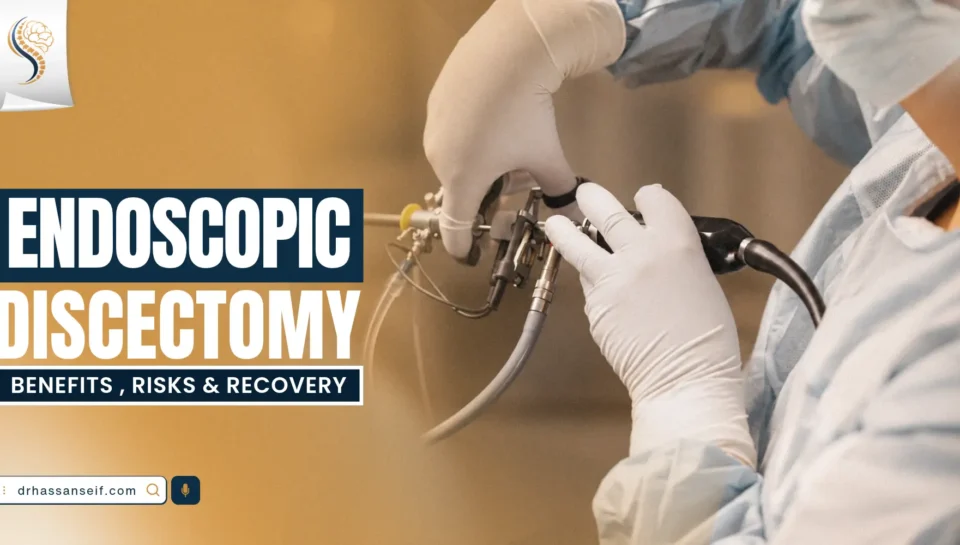
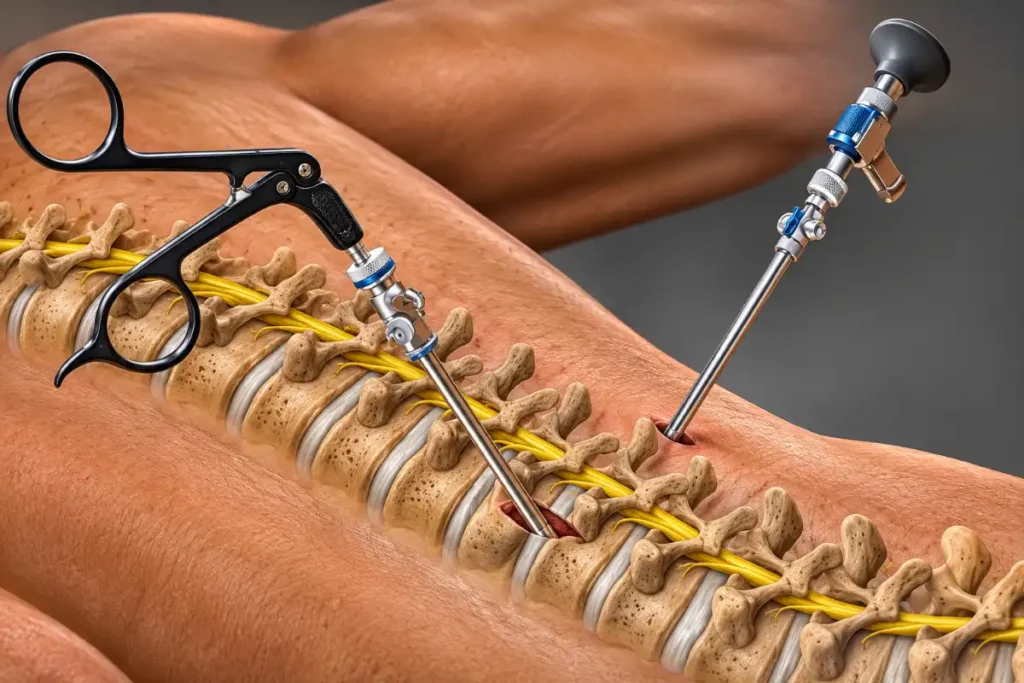
Endoscopic discectomy is a minimally invasive operation used to remove selected pieces of a herniated spinal disc that are pressing on a nerve.
A narrow camera and surgical instruments are passed through a small working channel, allowing the surgeon to see the affected area on a monitor. The aim is not to remove every part of the disc.
It is to release the compressed nerve while preserving healthy structures as far as the anatomy allows.
Patients usually investigate this procedure after persistent sciatica, radiating arm pain, tingling or weakness has been linked to a disc herniation. Yet a slipped disc on an MRI is not, by itself, an indication for surgery.
Some disc herniations cause no symptoms, and many painful episodes improve without an operation.
Whether endoscopic surgery is appropriate depends on the patient’s neurological examination, the location of the disc fragment, previous treatments and the expected benefit of decompression.
What Happens When a Spinal Disc Herniates?
- Spinal discs sit between vertebrae and help distribute movement and load. Each disc has an outer fibrous ring and a softer centre. A herniation occurs when disc material extends beyond its usual boundary.
- If it contacts or irritates a nearby nerve root, the patient may feel pain that travels along the nerve rather than pain confined to the back or neck.
- A lumbar disc herniation may produce sciatica, with pain travelling into the buttock, thigh, calf or foot. Numbness, altered sensation or weakness may accompany it.
- In the neck, a herniated disc may irritate a cervical nerve root and cause pain or symptoms in the shoulder, arm or hand.
- Symptoms vary according to the level involved, and not every area of tingling is caused by the spine.
Many people with a herniated disc improve with non-surgical care. This is why an assessment should establish both the source of symptoms and whether there is a reason to intervene sooner, such as progressive neurological weakness.
When Might Endoscopic Discectomy Be Considered?
Surgery becomes a consideration when a disc herniation clearly corresponds with troublesome nerve symptoms and non-surgical treatment has not provided sufficient improvement. There is no single waiting period suitable for every patient.
The severity of pain, degree of functional limitation and pattern of neurological findings all influence timing.
Features that may support a discussion about surgery include:
- Persistent sciatica or leg pain that matches lumbar nerve-root compression.
- Arm pain linked to a cervical disc in a suitable anatomical position.
- Difficulty walking, sleeping or carrying out work because of radiating nerve pain.
- Clinically significant neurological weakness or progressive functional limitation.
The examination and scans should tell a coherent story. If the imaging abnormality is on the opposite side from the symptoms, further evaluation may be needed before surgery is recommended.
Many patients first try activity modification, carefully selected medication, physiotherapy and, in some circumstances, a guided injection. These measures do not physically extract a disc fragment, but they may reduce inflammation and allow symptoms to settle.
A specialist may recommend earlier surgical assessment for worsening weakness or other serious neurological signs rather than waiting through a prolonged conservative programme.
Endoscopic Lumbar Discectomy and Cervical Discectomy: Are They the Same?
Endoscopic Lumbar Discectomy
Endoscopic lumbar discectomy treats selected herniations in the lower back.
A transforaminal route approaches the disc from the side through the region of the nerve exit, while an interlaminar route reaches it through the space between parts of adjacent vertebral arches.
The choice depends on the level, position and migration of the fragment, available working space and surgeon’s assessment. Certain fragments are more accessible through one route than the other.
Endoscopic Cervical Discectomy
Endoscopic cervical discectomy is a broader term covering selected techniques in the neck. For carefully chosen lateral disc or foraminal problems, a posterior endoscopic route may decompress a nerve root.
It is not interchangeable with every form of cervical disc surgery. Central disc compression, significant spinal cord involvement, instability or alignment concerns may call for a different operation, sometimes through an anterior approach.
The neck also contains different anatomical risks, so conclusions from lumbar studies should not automatically be applied to cervical procedures.
How Is the Procedure Planned and Performed?
1. Before Surgery
- The surgeon reviews the history, performs a focused neurological examination and studies the MRI to identify the likely symptomatic level. Sometimes CT imaging or other tests help clarify bone anatomy, instability or a possible alternative diagnosis.
- The team reviews medical conditions, medicines including blood thinners, allergies, infection risks and anaesthetic suitability.
- Patients should understand the intended target of the operation, likely benefits, alternative approaches and the possibility of a change in surgical plan if access proves unsuitable.
2. Positioning and Image Guidance
- For a lumbar procedure the patient is commonly positioned face down, with appropriate protection of pressure points. Anaesthesia may be general or, for selected approaches and centres, local anaesthesia with sedation.
- Imaging helps the surgeon confirm the correct spinal level and guide access. Some techniques use repeated fluoroscopy, which involves radiation exposure; the amount varies with technique and experience.
3. Accessing and Decompressing The Nerve
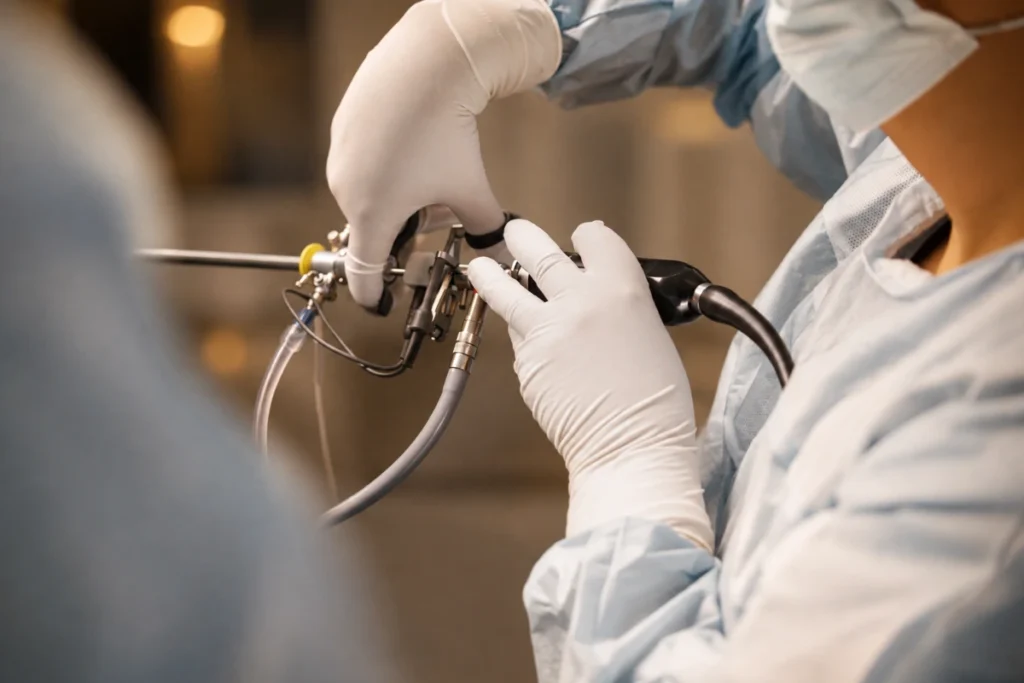
- Through a small skin incision, dilators and a working sheath create a route to the disc. The endoscope provides magnified visualisation with irrigation, and fine instruments remove the offending fragment when it can be reached safely.
- In some cases, a small amount of bone or ligament must also be addressed to create enough room. The key endpoint is adequate nerve decompression, not simply completing the procedure through the smallest incision.
4. Closing the Wound and Early Monitoring
- After the working instruments are withdrawn, the incision is closed and a dressing applied. The team checks pain control, movement, sensation and general recovery.
- Some patients can mobilise and go home relatively soon after an uncomplicated procedure, whereas others need longer observation because of neurological findings, anaesthesia, other medical conditions or local care arrangements. Same-day discharge should never be promised in advance.
What Are the Potential Benefits of Endoscopic Discectomy?
Possible benefits in carefully selected patients include:
- Less muscle dissection and tissue exposure around the operative corridor.
- Potentially less wound-related discomfort and blood loss.
- Earlier mobilisation and, in some settings, shorter hospital admission.
- Focused removal of the disc fragment responsible for nerve compression.
These are potential advantages of an access method, not guarantees of an uncomplicated recovery or a better final neurological result.
A multicentre randomised trial published in The BMJ found that a transforaminal endoscopic approach was not inferior to open microdiscectomy for reduction of leg pain in appropriately selected adults with sciatica.
It also reported some favourable recovery measures, although several between-group differences were small and might not be clinically important.
The study investigated a specific lumbar procedure in a defined patient population; it does not establish that every endoscopic operation is superior.
Preserving surrounding structures matters, but adequate decompression remains the priority. A limited incision does not make an operation minor in terms of proximity to the nerve root. Surgeon training, the exact pathology and the quality of intraoperative judgement are essential considerations.
What Does an Endoscopic Discectomy Success Rate Really Mean?
Patients often search for an endoscopic discectomy success rate expecting one percentage. There is no honest single number for all patients.
Studies may count success as improved leg pain, improved disability scores, patient satisfaction, avoidance of repeat surgery or return to work. These outcomes are not identical.
A person can report meaningful pain relief yet continue to have numbness or other symptoms caused by a longstanding nerve problem.
Disc location, duration of compression, degree of neurological impairment, smoking, general health, recurrence risk and the reason for surgery can all affect results. Research findings from one technique or hospital cannot be treated as a personalised prediction.
Dr. Hassan Seif’s assessment should instead focus on which symptom is most likely to improve, which may recover slowly and what the procedure cannot reliably correct.
Risks and Limitations of Endoscopic Discectomy
Endoscopic discectomy is surgery near delicate nerves and the protective covering around them. Important risks include:
- Infection, bleeding or complications related to anaesthesia.
- Nerve irritation or injury, including new pain, numbness or weakness.
- Dural tear and leakage of cerebrospinal fluid.
- Persistent symptoms or an incompletely removed compressive fragment.
- Recurrent disc herniation or the need for further surgery.
Serious neurological injury is uncommon but cannot be described as impossible.
Temporary burning, tingling or altered sensation can sometimes occur after manipulation of an irritated nerve. The small access channel can also limit manoeuvring space.
A surgeon may need to convert to a microscopic or open approach if visualisation or decompression is inadequate. This should be understood as a safety decision, not necessarily a procedural failure.
Not every disc is accessible through an endoscope. Large central compressive lesions, severe calcification, marked instability, complex multilevel disease and some revision operations may require different strategies.
An operation intended to relieve radiating nerve pain may not resolve unrelated mechanical back pain, hip disease or neuropathy.
Recovery After Endoscopic Discectomy
The first 24–72 hours
- Early walking is commonly encouraged when the team considers it safe. The wound may feel sore and some preoperative leg discomfort can fluctuate. Instructions vary on wound care, bathing, lifting, driving and medicines.
- Patients should avoid interpreting temporary postoperative discomfort as proof that decompression has failed, but significant worsening or new neurological signs require prompt review.
The first two to six weeks
Activity usually increases gradually. Recovery guidance commonly covers:
- Short walks and gentle tasks before strenuous exercise or heavy lifting.
- Wound care, medication use and any driving restrictions.
- A return-to-work plan tailored to physical job demands.
- Physiotherapy according to symptoms, strength and movement confidence.
An office worker and a person whose job involves repeated bending or lifting may have very different return-to-work plans. Rehabilitation should follow the operating team’s advice.
Longer-term recovery
- Radiating pain may improve earlier than numbness or weakness, especially when a nerve has been compressed for a long period. Nerve recovery can take months and may be incomplete.
- Strength, walking tolerance and confidence with normal movements are useful measures alongside pain scores. Follow-up also addresses the small but real possibility of recurrent herniation or persistent symptoms.
A safe rehabilitation plan should account for the patient’s previous activity level and type of surgery. No universal timeline accurately predicts when someone can return to running, gym training or a physically demanding occupation.
When Is Urgent Medical Attention Needed?
Seek urgent medical assessment for new difficulty passing urine, loss of bladder or bowel control, numbness around the saddle region, or rapidly developing weakness, particularly when associated with back or leg pain. These may indicate serious nerve compression.
Following surgery, new major weakness, loss of bladder control, a severe worsening of neurological symptoms, fever with wound concerns or fluid leaking from the wound also warrants urgent contact with the treating team or emergency services.