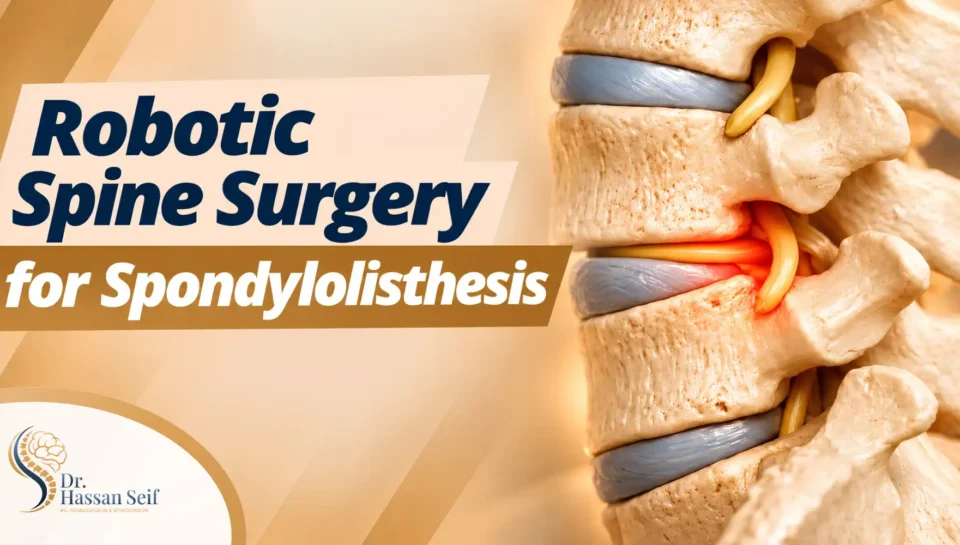

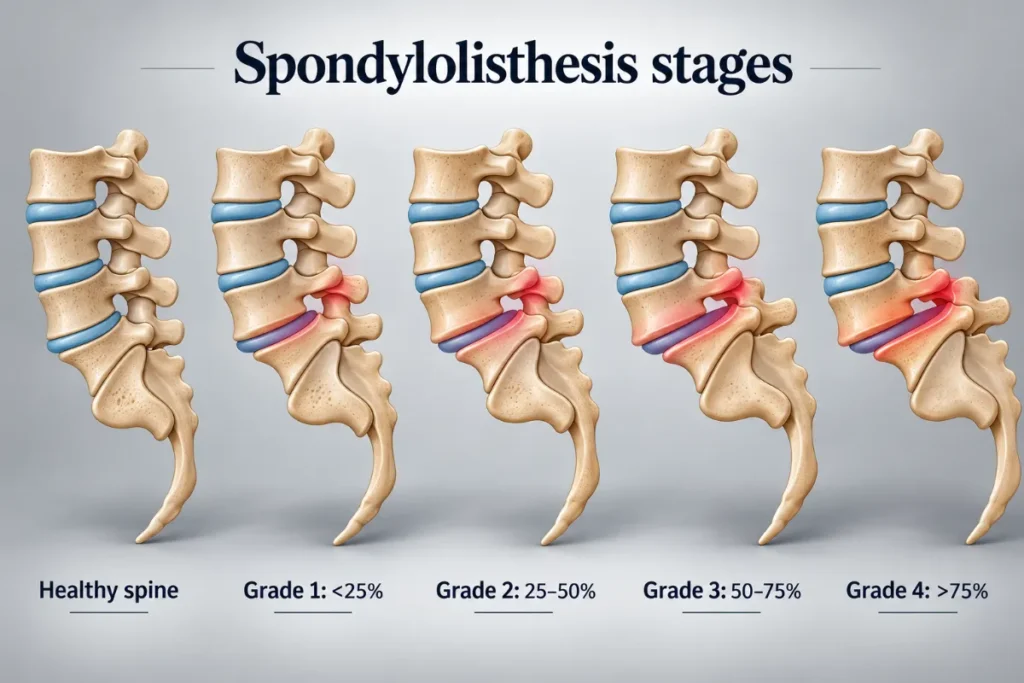
If an X-ray report says one vertebra has slipped over another, you may worry that your spine is unstable and that screws or fusion are inevitable. They are not. Spondylolisthesis means that one spinal bone has moved out of alignment relative to the one below it. Some slips cause no symptoms, some remain stable for years and some contribute to nerve compression or painful abnormal movement.
Robotic spine surgery for spondylolisthesis may be considered when a carefully selected patient needs spinal fixation or fusion. In that setting, the robot typically helps guide the placement of screws. It does not determine whether the slip needs surgery or whether fusion is preferable to decompression alone. Those choices depend on symptoms, examination, imaging and the type of instability.
What Is Spondylolisthesis, And Is It Similar To Spinal Instability?
Spondylolisthesis describes a vertebral slip. Instability means that the movement or lack of structural support at a spinal segment is clinically relevant, for example because it causes symptoms, threatens alignment or may affect the safety of a planned decompression. The two terms overlap, but they are not interchangeable. A slip seen on one image does not prove that the spinal segment is moving excessively.
Degenerative spondylolisthesis develops when discs and small spinal joints change over time, most often in the lower back. Isthmic spondylolisthesis is associated with a defect or stress injury in a part of the vertebra called the pars interarticularis. Less commonly, slippage can follow trauma, other bone disease or previous surgery. These causes matter because treatment and the likelihood of progression differ.
Spondylolisthesis can sometimes be painless. However, it may also cause back pain, tightness, leg pain, tingling or weakness. A patient with back pain and a small vertebral slip may have another underlying source of pain, so neither the X-ray finding nor the degree of slippage should be considered a complete diagnosis on its own.
When Is A Slipped Vertebra A Problem?
Some patients mainly experience back pain related to movement or loading. Others have a narrowed spinal canal or nerve-exit space and develop radiating leg symptoms, especially when standing or walking. There may be a combination of mechanical back pain and nerve compression. A careful history seeks to distinguish these patterns because the treatment goals differ.
Progressive loss of walking ability, objective weakness or persistent pain that substantially limits function deserves specialist assessment. However, imaging alone does not predict who will benefit from fusion. A stable, low-grade slip with manageable symptoms can often be monitored while the patient remains active and uses appropriate rehabilitation.
How Does The Doctor Assess Whether My Spine Is Unstable?
1. Clinical history and neurological examination
The assessment begins with where the pain is felt, what worsens it, whether the pain travels into a leg and how it affects work, sleep or walking. Examination may assess back and hip movement, sensation, reflexes, leg strength and gait. Severe pain can limit movement without meaning the spine is physically unstable, so the word ‘instability’ should be used carefully.
2. Standing X-rays and selected movement views
Standing X-rays show the alignment of the spine under normal load and the degree of vertebral slip. Flexion-extension X-rays may be used in selected cases to look for change in position between postures. Their interpretation is imperfect: patient effort, pain, positioning and measurement differences can influence what appears to move. There is no one numerical measurement that decides fusion for every patient.
3. MRI, CT and bone-health assessment
MRI helps evaluate nerve compression, disc changes, the spinal canal and surrounding soft tissues. CT may clarify bony defects or provide details needed for instrument planning. If fixation is under consideration, bone quality, smoking, diabetes, nutritional status and other factors that affect healing deserve attention. The imaging must be interpreted alongside examination rather than used as a substitute for it.
Does Spondylolisthesis Always Require Surgery?
No. When neurological function is stable and symptoms remain tolerable, a non-surgical plan may be appropriate. This can include physiotherapy that builds trunk and hip strength, graded exercise, changes to aggravating activities, appropriate medicines and monitoring. Some patients with nerve pain may be offered an injection for symptom relief, but an injection cannot physically correct a slip or fuse two vertebrae.
The treatment plan also depends on the type of spondylolisthesis. Advice for a young athlete with a pars stress injury is not necessarily appropriate for an older adult with degenerative facet-joint changes. A specialist should explain which activities are reasonable, rather than advising everyone to avoid bending or exercise indefinitely.
Treatment options for spondylolisthesis may include physiotherapy, activity adjustments, pain relief and selected injections. These measures can help patients improve mobility and regain everyday function, even when the X-ray appearance remains unchanged. Follow-up becomes more important if pain increases, walking ability deteriorates or neurological symptoms develop.
When Is Spinal Fusion Considered?
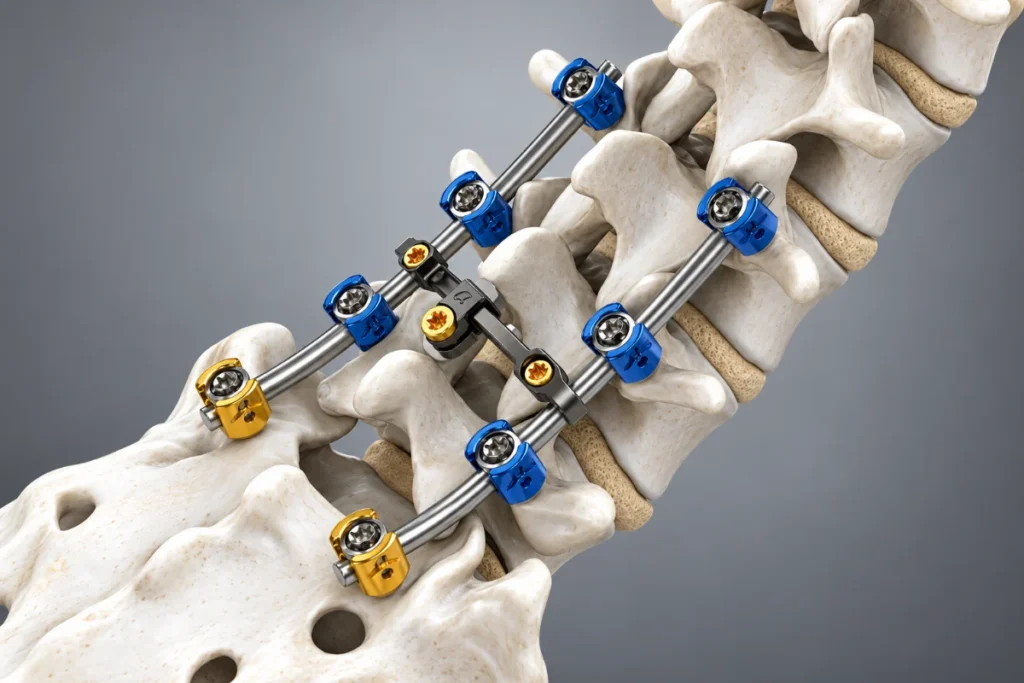
Fusion aims to create a solid connection between selected vertebrae so that problematic movement is reduced. It uses bone graft and sometimes an interbody cage, supported by screws and rods while the bone heals. A surgeon may consider fusion for selected patients with clinically important instability, significant deformity, intractable symptoms attributable to the unstable segment or a decompression that would otherwise leave the segment inadequately supported.
Fusion is not a general cure for back pain. It stops motion at the chosen segment, which is a meaningful trade-off. Risks include infection, blood loss, nerve injury, failure of bone to unite (non-union), implant problems and further degeneration or symptoms at nearby levels. The anticipated gain must be weighed against these possibilities and against the outcomes of continued conservative treatment.
Could Decompression Alone Be Enough If Nerves Are Compressed?
Yes, in appropriately selected patients. Decompression creates space for compressed nerves, while fusion aims to stabilise a spinal segment. If the dominant problem is leg pain from stenosis and the slip is stable, decompression alone may be reasonable. If instability is present or the decompression would create instability, fusion may be considered. The answer is not the same for every patient.
A five-year randomised trial published in The BMJ found decompression alone was non-inferior to decompression plus instrumented fusion for the main functional outcome in its studied group of people with degenerative spondylolisthesis and symptomatic stenosis. That finding should not be applied indiscriminately to patients with major deformity, severe foraminal narrowing, previous surgery at the same level or other patterns not well represented in the trial.
The 2025 AO Spine recommendations similarly emphasise that both approaches can be appropriate, with careful attention to features suggesting preoperative or postoperative instability. The available evidence is strongest for particular lower-grade degenerative cases; it does not establish that every unstable segment should be decompressed without fusion or that every visible slip should be fused.
What Is The Role Of Robotic Guidance During A Spinal Fusion?
If fixation is required, the surgeon may plan the desired position of pedicle screws using a 3D image of the vertebrae. A robotic guidance platform can align an instrument guide to that planned path. The surgeon then places the screws and checks their position, continuing with any decompression, grafting or cage placement needed for the selected procedure.
The robot is not independently realigning your vertebrae or making bone grow together. It assists with a technical step. Research comparing robotic and freehand pedicle screw placement often shows better radiographic placement accuracy with robotic methods. The 2024 comparative meta-analysis found that overall postoperative complications and several operative measures were not clearly different in the pooled studies, despite improved screw-position accuracy.
The more important question is whether accurately guided fixation is needed at all. When no screws are planned, there may be little reason to use a robotic screw-guidance system. When instrumentation is complex, the added planning and guidance can be valuable, but clinical benefit still depends on the operation chosen and on patient recovery.
For patients considering robotic spine surgery for spondylolisthesis in Al Ain, the choice between robotic-assisted and conventional fusion depends on spinal anatomy, the need for fixation and the surgeon’s clinical assessment.
Robotic Versus Conventional Fusion: Which Is Better For Me?
A conventionally performed fusion can use direct anatomy, X-ray guidance or independent computer navigation. A robot-assisted fusion adds a mechanism for aligning the surgical instruments to planned paths. Both approaches may use open or minimally invasive access. The choice may be influenced by anatomy, previous surgery, number of levels, availability of equipment and the surgeon’s experience.
For patients considering robotic spine surgery for spondylolisthesis in Al Ain, the choice between robotic-assisted and conventional fusion depends on spinal anatomy, the need for fixation and the surgeon’s clinical assessment.
Robotics can add set-up time, imaging requirements and equipment complexity. Errors in registration or unexpected patient movement may require the plan to be checked again, and conversion to another guidance method is possible. It should not be described as risk-free or as proven to produce superior long-term pain relief in every spondylolisthesis case.
Will Fusion Correct The Slip And Remove My Pain?
Sometimes a fusion operation includes a degree of realignment, but correction is not always the main objective and complete restoration of the original anatomy may be unnecessary or unsuitable. The aims can include protecting nerves, improving alignment where needed and reducing painful movement. The level of correction chosen must balance potential benefits against stretching or injuring nerves and other surgical risks.
Similarly, relief of leg pain and recovery of strength are not identical to relief of long-standing back pain. Bone fusion can be technically successful while some symptoms persist. Other sources of pain, nerve damage that predates surgery or adjacent joint disease may continue to affect function. An honest discussion should identify which symptoms are likely to improve and which are less predictable.
What Are The Main Risks Of Instrumented Fusion?
Risks include bleeding, infection, blood clots, anaesthetic complications, injury to nerves or their protective covering, residual or recurrent symptoms, misplaced or loosened screws and further surgery. If the graft does not form a solid bridge between vertebrae, a painful non-union may develop. Reduced bone strength, nicotine exposure and certain medical conditions may affect this risk.
Robotic guidance can assist with screw positioning, but it does not eliminate the broader risks associated with spinal surgery. Different spinal conditions may require different surgical techniques, and minimally invasive procedures also carry risks. The consent process should therefore reflect the patient’s individual condition and planned procedure, rather than focusing solely on the technology being used.
Recovery After Robotic Spondylolisthesis Surgery
The first phase concerns wound care, pain control and safe movement. Later phases focus on building walking tolerance, returning to desk or physical work and gradually restoring strength. If fusion has been performed, the graft needs months to mature; radiographic healing is a different milestone from feeling well enough to walk or work.
The pace depends on the number of fused levels, approach, degree of nerve compression, bone health, age, occupation and any additional procedures. Returning to heavy lifting or sport requires individual clearance. A robot does not shorten the biology of bone healing, and a small incision does not automatically justify a shorter rehabilitation plan.
What If I Choose Observation Instead?
When the slip is stable and symptoms are manageable, monitoring may be sensible. The clinician may review symptoms, physical function and any changing neurological findings, with further imaging only when it answers a relevant question. Treatment can be reconsidered if walking becomes severely restricted, pain remains unacceptable despite care, or new objective deficits appear.
Some circumstances cannot wait for a routine appointment. New loss of bladder or bowel control, inability to pass urine, altered sensation around the genitals or rapidly increasing leg weakness should prompt emergency hospital assessment. The AANS guidance on cauda equina syndrome explains why these changes need urgent investigation.
What To Discuss With A Spine Specialist In Al Ain
Dr. Hassan Seif, Consultant Neurosurgeon and Spine Surgeon in Al Ain, considers whether the slip itself is responsible for symptoms, whether there is nerve compression and whether meaningful instability has been demonstrated. The decision is then between continued conservative care, targeted decompression, fusion or a combined approach, rather than between ‘robotic’ and ‘non-robotic’ surgery in isolation.
If robotics is discussed, ask what part of the operation it will assist, whether there are alternatives such as conventional navigation, the expected recovery and the surgeon’s experience with the system. In Abu Dhabi, the Department of Health scope-of-practice guidance links surgical activities to professional licensing, competency and facility privileges. Current robotic equipment, authorisation and suitability should be confirmed with the licensed treating hospital; international regulatory guidance does not establish local availability.