

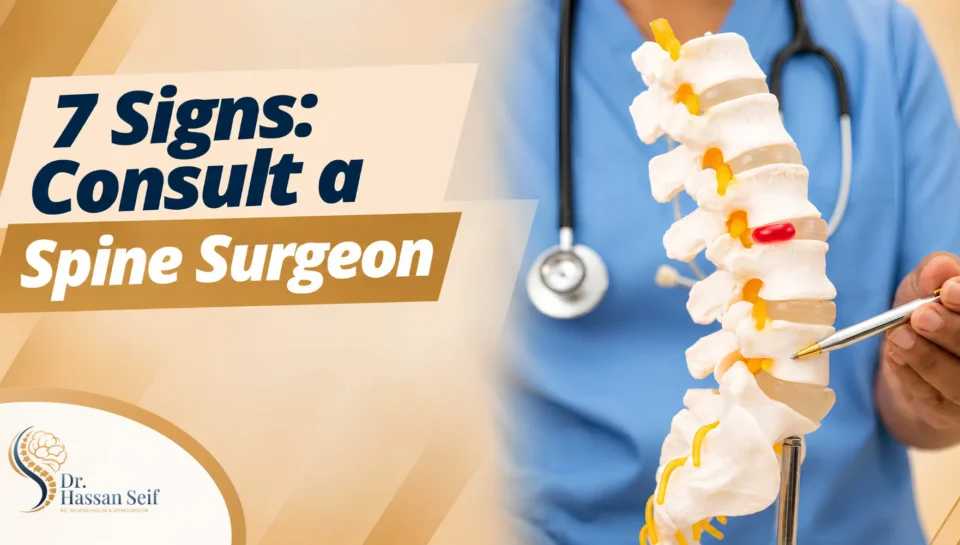

Back pain after a long day, neck stiffness after hours at a desk, or occasional discomfort after exercise does not usually mean you need a spine surgeon.

But there are times when back or neck symptoms begin to tell a different story.

Pain may start travelling into your leg or arm. Your hand may feel numb. One foot may become weaker. You may notice that walking is becoming more difficult, or that the symptoms keep returning despite medication and physiotherapy.

These changes deserve a closer look.

For patients searching for a Spine Surgeon Abu Dhabi, one of the most important things to understand is that seeing a spine surgeon does not automatically mean you will need surgery.

A spine specialist’s first job is to determine what is causing your symptoms, whether your nerves or spinal cord are involved, and what treatment is actually appropriate.

Many spinal conditions can be managed without surgery. Specialist assessment becomes particularly valuable when symptoms persist, progress, affect neurological function, or no longer respond as expected to conservative treatment.

Here are seven signs that it may be time to seek a specialist spine assessment.

1. Your Back or Neck Pain Is Not Improving

Most people experience back or neck pain at some point.

In many cases, uncomplicated back pain improves with time, appropriate activity, pain management, and rehabilitation. But persistent pain deserves more attention, particularly when it continues despite appropriate treatment or significantly interferes with normal life.

The American Association of Neurological Surgeons notes that uncomplicated lower back pain can often initially be managed conservatively when neurological symptoms are absent.

The situation becomes different when pain:

  • Continues for several weeks
  • Keeps returning frequently
  • Is progressively getting worse
  • Prevents you from sleeping normally
  • Makes sitting, standing, or walking difficult
  • Stops you from exercising or working
  • Does not respond as expected to conservative treatment

Persistent pain does not necessarily mean you need an operation. It means the cause may need to be investigated more carefully.

Conditions such as disc herniation, spinal stenosis, degenerative changes, instability, nerve compression, and other spinal problems can produce persistent symptoms. The goal of a specialist assessment is to identify the actual pain generator rather than simply continue treating the symptom.

If you have already tried medication, physiotherapy, or lifestyle adjustments and the same problem continues to return, consulting a spine specialist can help clarify what should happen next.

2. Pain Travels Down Your Leg or Into Your Arm

Man experiencing lower back pain radiating down the leg, a common symptom of sciatica
Pain that remains localised to the back or neck can have many causes.

Pain that travels along an arm or leg raises another possibility: a spinal nerve may be irritated or compressed.

In the lower back, nerve compression can produce pain that travels through the buttock and down the leg. This is commonly called sciatica.

A herniated lumbar disc, for example, can compress a nearby nerve and cause pain, sensory changes, or weakness in the affected leg.

Patients may describe this pain as:

  • Shooting
  • Burning
  • Electric
  • Sharp
  • Stabbing
  • Like an electric shock

The same principle applies in the neck.

Compression of a cervical nerve can cause symptoms that extend from the neck into the shoulder, arm, hand, or fingers.

Why does this matter?

Because pain travelling along a nerve tells us something different from muscle soreness alone.

A spine surgeon will consider not only where the pain begins but also where it travels, which movements aggravate it, and whether the pattern corresponds to a particular spinal nerve.

This can help distinguish nerve related pain from muscular, joint, or peripheral nerve conditions.

3. You Have Persistent Numbness or Tingling

Occasional pins and needles after sitting awkwardly are common.

Persistent numbness is different.

If you repeatedly experience numbness, tingling, reduced sensation, or an unusual altered feeling in your arm, hand, leg, or foot, it may indicate involvement of a nerve.

Neurological symptoms associated with spinal conditions can include numbness, weakness, and tingling. The AANS advises medical evaluation when neurological symptoms accompany lower back pain.

What matters clinically is not simply whether numbness exists.

A specialist will want to know:

  • Where exactly is the numbness?
  • Is it constant or intermittent?
  • Is it spreading?
  • Is it getting worse?
  • Does it affect one side or both?
  • Is there weakness as well?
  • Does the sensory pattern correspond to a spinal nerve?

These details can provide important clues.

For example, numbness affecting a specific group of fingers could potentially arise from a nerve in the neck, but similar symptoms can also occur with peripheral nerve conditions such as carpal tunnel syndrome.

This is one reason specialist assessment matters.

The symptom may be in the hand or foot, while the source of the problem may be somewhere else.

Persistent or progressive sensory changes should therefore not simply be ignored because the pain itself is manageable.

4. You Are Developing Weakness

Weakness is one of the most important signs on this list. There is a significant difference between saying:

“My leg hurts too much to move normally.”

and

“My leg genuinely cannot produce the strength it used to.”

True muscle weakness can indicate that a nerve responsible for controlling that muscle is being affected.

In the lower spine, patients may notice:

  • Difficulty lifting the front of the foot
  • A foot that drags while walking
  • Difficulty walking on the heels
  • Difficulty standing on the toes
  • Repeated tripping
  • One leg becoming noticeably weaker

Progressive neurological deficits, including leg weakness and foot drop, are recognised reasons for specialist consideration in conditions such as lumbar spinal stenosis. Problems in the cervical spine can also affect strength.

You may notice:

  • Reduced grip strength
  • Difficulty holding objects
  • Frequently dropping things
  • Difficulty with buttons or other fine hand movements
  • Weakness in the arm or hand

New weakness should not simply be managed with repeated pain medication without determining why it is happening.

A spine specialist can perform a neurological examination to assess muscle power, sensation, reflexes, coordination, and other functions.

If weakness is progressively worsening, earlier medical assessment becomes particularly important.

5. Your Balance or Walking Has Changed

Sometimes a spinal problem does not present primarily as severe pain. The first noticeable change may be the way you walk.

Person walking with difficulty, illustrating changes in walking that may occur with spinal problems

You might find yourself:

  • Feeling unsteady
  • Walking more slowly
  • Struggling with balance
  • Needing to hold onto furniture
  • Finding stairs increasingly difficult
  • Feeling that your legs are heavy
  • Unable to walk as far as before

There are several possible reasons for these symptoms.

For example, lumbar spinal stenosis can narrow the space available for the nerves in the lower spine. In more advanced cases, neurological changes can include leg weakness, numbness, and difficulty walking.

Problems higher in the spine can also affect walking and balance if the spinal cord becomes compressed.

This is why an assessment should not focus only on the location or intensity of pain.

A patient might say:

“My neck does not hurt that much, but my walking has changed.”

Clinically, that change may be more important than the pain score.

If you have noticed a new or progressive change in balance, coordination, leg control, or walking ability, it is worth discussing with an appropriate specialist.

6. Your Symptoms Keep Returning Despite Treatment

Many patients do well with conservative treatment.

Depending on the condition, that may include:

  • Medication
  • Physiotherapy
  • Activity modification
  • Exercise rehabilitation
  • Posture or ergonomic changes
  • Weight management
  • In selected cases, spinal injections

The fact that symptoms initially improve is encouraging.

But what if the same severe pain returns repeatedly?

What if every improvement lasts only a short time?

Or what if months of treatment have improved the pain slightly but you still cannot walk, work, exercise, or sleep comfortably?

That is when the question needs to change from:

“How can I reduce the pain again?”

to:

“Why does this keep happening?”

A spine consultation can help determine whether the current diagnosis is correct, whether imaging is needed, whether an existing MRI finding actually matches the symptoms, and whether another treatment option should be considered.

This still does not mean surgery is inevitable.

For example, most symptomatic lumbar disc herniations improve without surgery, and surgery is typically considered when there is an appropriate clinical indication rather than simply because a disc abnormality appears on imaging.

The important point is that persistent symptoms deserve reassessment when the existing treatment plan is no longer achieving its goal.

7. You Develop Bladder, Bowel, Saddle Sensation, or Rapidly Progressive Neurological Changes

This final category is different from the others.

These symptoms should not simply lead to a routine appointment with a Spine Surgeon Abu Dhabi. They can require urgent emergency medical assessment.

Seek urgent medical attention if severe back or leg symptoms are accompanied by:

  • New difficulty starting or controlling urination
  • Loss of bladder control
  • Loss of bowel control
  • Numbness around the genitals
  • Numbness around the inner thighs or buttocks
  • Rapidly worsening weakness in one or both legs
  • Significant new neurological changes

These can be warning signs of cauda equina syndrome, a rare but serious condition involving compression and dysfunction of multiple nerve roots at the lower end of the spinal canal.

Recognised symptoms include lower limb weakness, altered sensation in the saddle area, and changes in bladder or bowel function. Urgent assessment is important because delayed treatment can lead to permanent neurological impairment.

The important message here is simple:
Do not wait for a routine clinic appointment if these symptoms suddenly develop. Seek emergency medical care.

Does Seeing a Spine Surgeon Mean You Need Surgery?

No. You do not need to wait until you are certain you require an operation before seeing a spine surgeon.

In fact, determining whether surgery is necessary or not is part of the consultation.

A spine surgeon may recommend:

  • Observation
  • Physiotherapy
  • Rehabilitation
  • Medication
  • Lifestyle modification
  • Further diagnostic testing
  • Injections
  • Monitoring
  • Surgery, when there is a clear indication

The right treatment depends on the diagnosis, the patient’s neurological function, the severity and duration of symptoms, imaging findings, previous treatment, and the impact the condition is having on everyday life.

Surgery is one treatment option within spine care. It is not automatically the first one.

Maecenas vestibulum iaculis orci. In ut cursus lectus. Nullam semper vel ante at imperdiet. Quisque posuere vitae sem ac elementum. Sed a commodo mauris. Aliquam blandit, turpis ut faucibus consequat, augue tellus aliquet metus, eu posuere nibh risus et sapien. Morbi sit amet lorem auctor lacus efficitur ornare.

When Should You Get an MRI?

An MRI can provide detailed information about the discs, spinal canal, spinal cord, and nerves. However, not everyone with back or neck pain requires immediate imaging.

The decision depends on the symptoms and examination.

MRI: Man experiencing persistent lower back pain and seeking evaluation for a spinal condition

Imaging becomes more clinically relevant when there is:

  • Persistent radiating pain
  • Neurological weakness
  • Progressive numbness
  • Walking or balance changes
  • Symptoms that fail to improve as expected
  • Concern about significant nerve or spinal cord compression
  • A need to plan specialist treatment

The scan is most useful when it answers a clinical question.

An MRI should therefore be interpreted alongside the patient’s history and neurological examination rather than in isolation.

This matters because treating an abnormal looking scan without confirming that it explains the patient’s symptoms can lead to unnecessary treatment.

What Happens During a Spine Surgeon Consultation?

If you are seeing a spine surgeon for the first time, the consultation should involve much more than simply reviewing an MRI. The specialist will usually begin by understanding your symptoms.

This can include questions about:

  • When the pain started
  • Whether pain travels into an arm or leg
  • Where numbness occurs
  • Whether you have noticed weakness
  • Whether walking has changed
  • What treatments you have already tried
  • Whether symptoms are progressing
  • How the condition affects work, sleep, exercise, and daily life

A neurological examination may then evaluate:

  • Muscle strength
  • Sensation
  • Reflexes
  • Walking
  • Coordination
  • Balance
  • Nerve tension

If imaging is available, it can then be compared with the clinical findings.

That sequence is important.

An MRI is a tool to help understand your symptoms. Your symptoms should guide how the MRI is interpreted.

How Do You Choose a Spine Surgeon in Abu Dhabi?

If you are searching online for a Spine Surgeon Abu Dhabi, it can be difficult to know what actually matters.

Rather than choosing based only on a list of procedures, consider looking at the specialist’s overall approach.

A comprehensive spine assessment should focus on:

1. Clinical and neurological evaluation

The specialist should understand the symptoms before making decisions based on imaging.

2. Experience with both surgical and nonsurgical pathways

Good spine care includes recognising when surgery may help and, equally importantly, when it may not be necessary.

3. Appropriate use of minimally invasive techniques

When surgery is indicated, the chosen technique should be appropriate for the specific pathology and patient rather than selected simply because it is newer technology.

4. Clear communication

You should understand your diagnosis, the available options, the expected benefits, and the potential risks before making a treatment decision.

Dr. Hassan Seif is a German trained Consultant Neurosurgeon and Spine Surgeon practising at SEHA Sheikh Tahnoon Bin Mohammed Medical City and Tawam Hospital in Al Ain, Abu Dhabi Emirate. His current specialist profile includes minimally invasive, full endoscopic, and robotic spine surgery alongside neurosurgical care.

When Your Spine Symptoms Are Starting to Change Your Life

The question is not simply whether your back or neck hurts.

The more important questions are:

  • Is the pain travelling?
  • Are you losing sensation?
  • Is a muscle becoming weaker?
  • Has your walking or balance changed?
  • Are the symptoms becoming more frequent or harder to control?

These details can help distinguish a temporary episode of back or neck pain from a condition that deserves specialist evaluation.

If you have persistent back or neck pain, radiating nerve pain, numbness, weakness, or symptoms that have not improved with appropriate treatment, you do not need to wait until the problem becomes unbearable before asking for a specialist opinion.

If you are looking for an experienced Spine Surgeon in Abu Dhabi, book a consultation with Dr. Hassan Seif for a comprehensive assessment of your symptoms, neurological function, and imaging.

The aim of the consultation is not to find a reason to operate.

It is to identify the real cause of your symptoms, understand which treatment options are appropriate, and help you make an informed decision about your spine health.
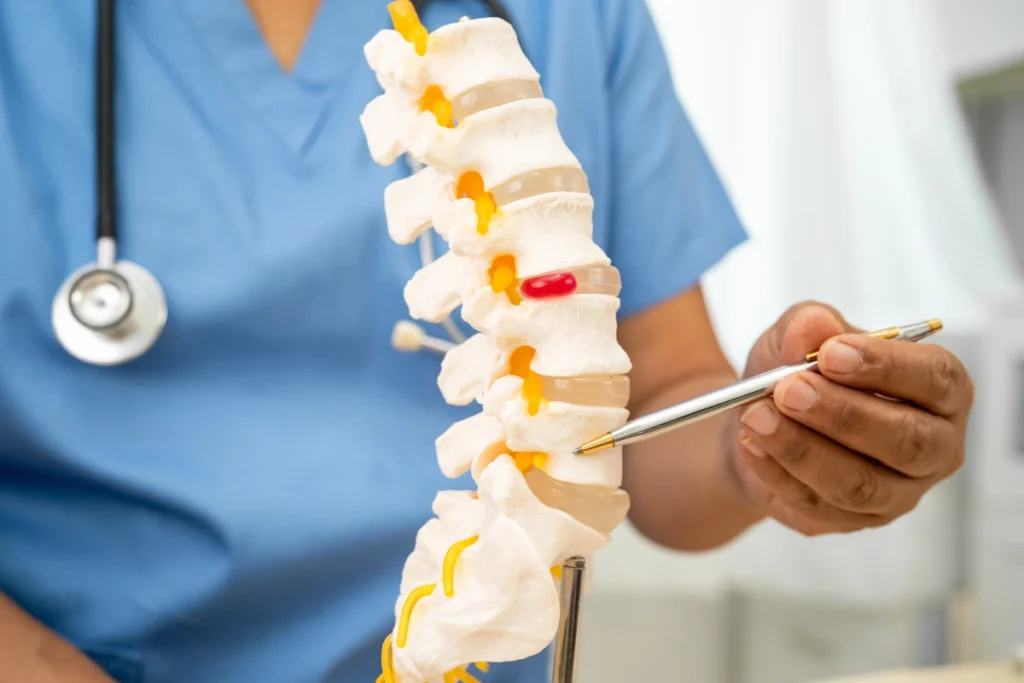

Spine surgeon examining a spinal model to assess a possible spinal condition

Frequently Asked Questions

1. When should I see a spine surgeon for back pain?

Consider specialist assessment when back pain is persistent, repeatedly returning, associated with radiating leg pain, numbness, weakness, or walking changes, or when appropriate conservative treatment has not produced the expected improvement.

2. Should I see a spine surgeon for sciatica?

Not every case of sciatica needs surgical treatment. However, specialist assessment may be useful when sciatica is severe, persistent, associated with numbness or weakness, or continues despite appropriate conservative management. Disc herniation is one recognised cause of sciatica.

3. Does numbness mean I need spine surgery?

No. Numbness alone does not determine whether surgery is required.

Its cause, location, duration, progression, neurological examination, and imaging findings all need to be considered.

4. Is leg weakness more serious than back pain?

New or progressive neurological weakness deserves prompt assessment because it can indicate impaired nerve function. Conditions causing nerve compression can produce weakness, numbness, and, in more serious situations, bladder or bowel dysfunction.

5. Do I need an MRI before seeing a spine surgeon?

Not necessarily.

A specialist can first assess your symptoms and neurological function, then determine whether MRI or another investigation is appropriate.

If you already have an MRI, bringing the images and report can help the specialist compare the findings with your symptoms.

6. Will a spine surgeon always recommend surgery?

No. Many spinal conditions can be managed nonsurgically. The purpose of specialist assessment is to identify the cause and determine the most appropriate treatment, which may or may not involve surgery. Herniated disc symptoms, for example, often improve without an operation.

7. What symptoms need emergency assessment?

New bladder or bowel dysfunction, numbness around the saddle area, or severe and rapidly progressive neurological weakness can indicate serious nerve compression and require urgent medical assessment.

Reviewed By
Dr Hassan Seif
German-Trained Consultant Neurosurgeon and Spine Surgeon

Medical Disclaimer
This article is intended for general educational purposes and does not replace an individual medical consultation.

Item #1

Lorem ipsum dolor sit amet, consectetur adipiscing elit. Ut elit tellus, luctus nec ullamcorper mattis, pulvinar dapibus leo.

1. When should I see a spine surgeon for back pain?

Consider specialist assessment when back pain is persistent, repeatedly returning, associated with radiating leg pain, numbness, weakness, or walking changes, or when appropriate conservative treatment has not produced the expected improvement.

1. When should I see a spine surgeon for back pain?

Consider specialist assessment when back pain is persistent, repeatedly returning, associated with radiating leg pain, numbness, weakness, or walking changes, or when appropriate conservative treatment has not produced the expected improvement.

1. When should I see a spine surgeon for back pain?

Consider specialist assessment when back pain is persistent, repeatedly returning, associated with radiating leg pain, numbness, weakness, or walking changes, or when appropriate conservative treatment has not produced the expected improvement.

1. When should I see a spine surgeon for back pain?

Consider specialist assessment when back pain is persistent, repeatedly returning, associated with radiating leg pain, numbness, weakness, or walking changes, or when appropriate conservative treatment has not produced the expected improvement.

1. When should I see a spine surgeon for back pain?

Consider specialist assessment when back pain is persistent, repeatedly returning, associated with radiating leg pain, numbness, weakness, or walking changes, or when appropriate conservative treatment has not produced the expected improvement.