


What Is a Herniated Disc?
Your spine is made up of bones called vertebrae. Between these bones are intervertebral discs that help absorb pressure and allow the spine to move.
Each disc has a strong outer layer and a softer centre.
A herniated disc occurs when part of the softer inner material pushes through or beyond the outer layer of the disc. Herniated discs can occur at different levels of the spine, but they are particularly common in the lower back.
The disc itself may contribute to back pain, but symptoms can become more significant when the displaced disc material irritates or compresses a nearby spinal nerve.
That nerve involvement is often what creates the characteristic symptoms that help us distinguish a herniated disc from more general lower back pain.

What Are the Most Common Herniated Disc Symptoms?
Your spine is made up of bones called vertebrae. Between these bones are intervertebral discs that help absorb pressure and allow the spine to move.
Each disc has a strong outer layer and a softer centre.
A herniated disc occurs when part of the softer inner material pushes through or beyond the outer layer of the disc. Herniated discs can occur at different levels of the spine, but they are particularly common in the lower back.
The disc itself may contribute to back pain, but symptoms can become more significant when the displaced disc material irritates or compresses a nearby spinal nerve.
That nerve involvement is often what creates the characteristic symptoms that help us distinguish a herniated disc from more general lower back pain.
There is no single symptom that confirms a herniated disc.
Symptoms depend on the location of the herniation, which nerve is affected, and the degree of nerve irritation or compression. A herniated disc that does not press on a nerve may cause only lower back discomfort or no symptoms at all. When a nerve is involved, pain, numbness, tingling, or weakness can develop along the area supplied by that nerve.
Some of the most important herniated disc symptoms include:
1. Pain That Travels Down the Leg
One of the strongest clues that a lumbar disc may be irritating a nerve is pain that travels beyond the lower back.
The pain may begin around the lower back or buttock and continue into the thigh, calf, or foot.
This type of radiating nerve pain is commonly known as sciatica.
Patients often describe the pain as:
- Sharp
- Shooting
- Burning
- Electric
- Stabbing
- Like an electric shock running down the leg
In some cases, the leg pain may actually be more severe than the lower back pain. The symptoms often affect one side, depending on which nerve root is involved.
This is an important distinction.
If your pain remains only in the centre of the lower back, a herniated disc is still possible, but there are also many other potential causes.
If the pain follows a clear pathway from the back or buttock into one leg, nerve irritation becomes more relevant.
2. Tingling or Pins and Needles
A compressed nerve does not always produce pain alone.
Some patients notice:
- Pins and needles
- Tingling
- Altered sensation
- A strange buzzing sensation
- Reduced feeling in part of the leg or foot
Where you feel these symptoms can be clinically useful because different nerve roots supply different areas of the leg and foot.
During an assessment, a spine specialist does not simply ask whether tingling is present. The location and pattern of the altered sensation can help identify which nerve may be involved.
Tingling or numbness in the leg or foot is recognised as a common symptom when a lumbar herniated disc affects a nearby nerve.
3. Numbness in the Leg or Foot
Numbness can sometimes be more concerning to patients than pain, particularly when it persists even after the pain begins to improve.
This is an important point.
Pain and nerve recovery do not always happen at the same speed.
A patient may say:
“My leg pain is much better, but part of my foot is still numb.”
That does not automatically mean the condition is worsening, but persistent or increasing sensory loss should be clinically assessed, particularly if it is accompanied by weakness.
After treatment for lumbar disc herniation, pain often improves before sensation fully recovers.
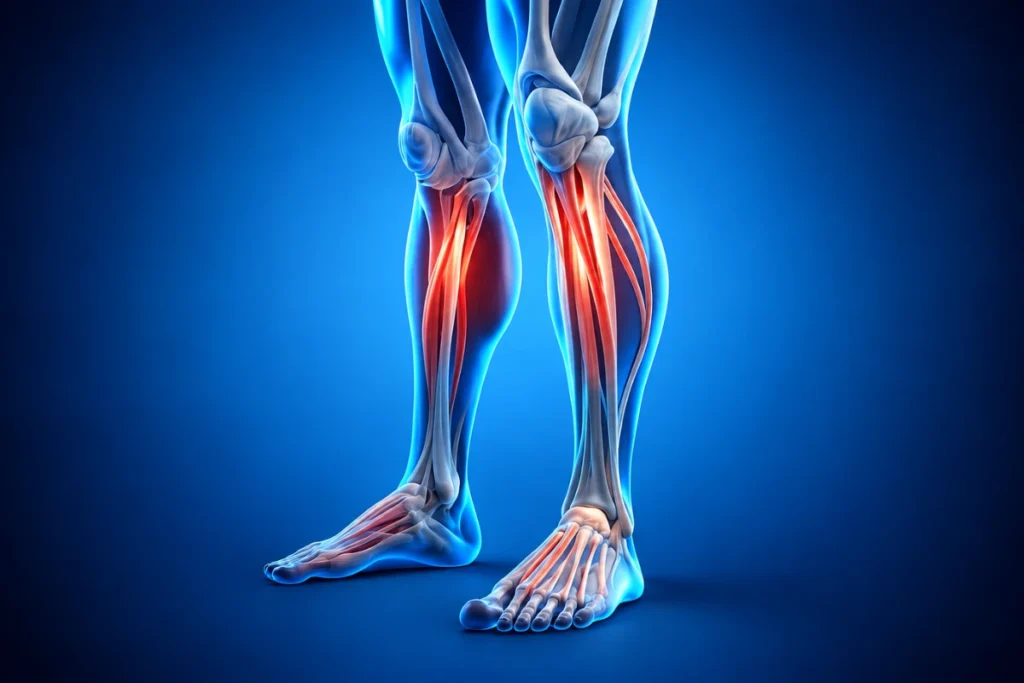
4. Weakness in the Leg or Foot
Weakness is different from pain.
If a nerve responsible for controlling a particular muscle becomes significantly affected, the patient may develop measurable muscle weakness.
You might notice that:
- One leg feels weaker than the other
- You have difficulty lifting the front of your foot
- Your foot starts dragging when walking
- Walking on your heels becomes difficult
- Standing on your toes becomes difficult
- You are tripping more frequently
- Climbing stairs feels unusually difficult
During a neurological examination, the doctor may assess muscle strength, reflexes, sensation, heel walking, toe walking, and other movements to determine whether a particular nerve root is being affected.
New or progressive weakness deserves medical assessment.
Pain can be unpleasant, but progressive weakness may indicate an increasing effect on nerve function.
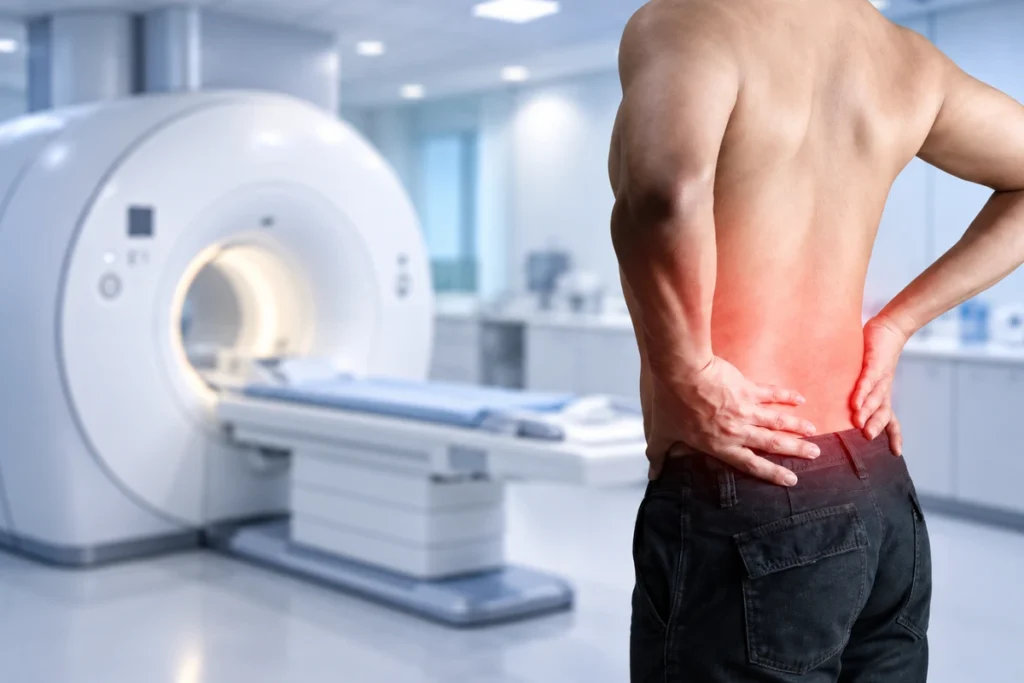
Can an MRI Tell You If Your Back Pain Is From a Herniated Disc?
MRI is one of the most useful tools available for evaluating discs, spinal nerves, and other soft tissues around the spine.
But an MRI does not diagnose the cause of pain by itself.
This distinction matters.
A scan may identify:
- Disc degeneration
- Disc bulging
- Disc protrusion
- Disc herniation
- Narrowing around a nerve
- Other age related changes
Yet some of these findings can occur in patients who have no symptoms.
So, if an MRI report says “disc herniation”, the next question should not automatically be:
“Do I need surgery?”
The better question is:
“Does this disc herniation explain my symptoms?”
For example, imagine that an MRI shows a herniated disc compressing a nerve on the right side.
If the patient also has pain travelling down the right leg, numbness in the expected area, weakness in muscles supplied by that nerve, and examination findings that correspond to the same nerve root, the MRI finding becomes much more meaningful.
That is what we mean when we say that the scan should match the patient.
Do You Need an MRI for Every Episode of Back Pain?
No.
Most patients with uncomplicated lower back pain do not automatically require immediate MRI imaging.
The American Association of Neurological Surgeons notes that MRI is generally not recommended immediately in uncomplicated cases and that earlier imaging becomes more important when there are concerning neurological findings or other red flags.
A specialist may consider MRI when there is:
- Persistent radiating leg pain
- Significant or progressive numbness
- Muscle weakness
- Progressive neurological changes
- Symptoms that are not improving as expected
- Suspicion of another underlying spinal condition
- A need to plan more advanced treatment
The MRI should be requested because it can help answer a clinical question, not simply because back pain exists.
What Happens During a Spine Assessment?
A good spine assessment in Al Ain begins before looking at the scan.
Your doctor will usually ask about the onset, duration, location, and pattern of your symptoms.
You may be asked:
- Did the pain begin suddenly or gradually?
- Does it stay in the back or travel into the leg?
- Which part of the leg is affected?
- Do you have numbness or tingling?
- Have you noticed weakness?
- Are you walking differently?
- What makes the symptoms better or worse?
- Have your bladder or bowel habits changed?
The physical examination can then include assessment of muscle power, sensation, reflexes, walking, and specific nerve tension tests. The straight leg raise test is one examination commonly used when lumbar disc herniation is suspected.
Only after combining this information does imaging become truly meaningful.
Can Herniated Disc Symptoms Improve Without Surgery?
Yes.
A herniated disc does not automatically mean surgery.
In fact, most patients with lumbar disc herniation improve without an operation. The AANS reports that symptoms of sciatica or radiculopathy improve over time in approximately nine out of ten patients, although the recovery period can vary.
AAOS also notes that most patients improve over a period of several days to weeks and that initial treatment is generally nonsurgical.
Depending on the individual case, management may involve:
- Modification of aggravating activities
- Appropriate pain relief
- Anti inflammatory medication when suitable
- Physiotherapy
- Rehabilitation
- Gradual return to normal activity
- In selected patients, spinal injections
- Monitoring of neurological symptoms
The treatment plan should always be personalised according to the patient’s symptoms, examination findings, lifestyle, general health, and imaging.
When Might Surgery Be Considered?
Surgery is generally considered when there is a clear reason to operate rather than simply because a disc appears on MRI.
Potential reasons include:
- Persistent disabling nerve pain despite appropriate nonsurgical treatment
- Progressive muscle weakness
- Significant neurological deficit
- Difficulty standing or walking because of the nerve problem
- Symptoms that continue to substantially affect daily function
- Loss of normal bladder or bowel control
Both AANS and AAOS describe progressive neurological deficits, significant weakness, walking difficulty, and bladder or bowel dysfunction among the circumstances in which surgical assessment may become important.
The purpose of surgery is not to correct every abnormality seen on imaging.
It is to treat a structural problem when there is good clinical evidence that it is responsible for the patient’s symptoms and when surgery is likely to offer meaningful benefit.
Which Herniated Disc Symptoms Require Urgent Attention?
Most cases of back pain and sciatica are not emergencies.
However, certain symptoms should never be ignored.
Seek urgent medical attention if you develop:
- New difficulty passing urine
- Loss of bladder control
- Loss of bowel control
- Numbness around the genitals, buttocks, or inner thighs
- Severe or rapidly worsening weakness in one or both legs
- Major neurological changes affecting walking
These can be warning signs of cauda equina syndrome, a rare but serious condition involving dysfunction of multiple nerve roots in the lower spine.
AANS identifies urinary retention, bladder or bowel dysfunction, saddle area sensory disturbance, and lower limb weakness among the important warning signs requiring immediate medical assessment.
Progressively worsening weakness should also be evaluated promptly even when bladder and bowel function are normal.



3 Comments
Heather Smith
April 24, 2024, at 9:58 amSed at nulla vel elit molestie rutrum non nec orci. Mauris varius, odio rutrum iaculis sagittis, erat urna luctus nisl, at tempor turpis mi at diam. Vestibulum ullamcorper neque eu sapien congue, a ultrices risus faucibus. Ut et felis non ipsum maximus laoreet. Curabitur iaculis bibendum.
Heather Smith
April 25, 2024, at 3:10 amLorem ipsum dolor sit amet, consectetur adipiscing elit. Fusce elementum, eros et scelerisque hendrerit, nisi augue placerat metus, at consequat justo lacus a ligula. Integer eget leo ac neque sagittis scelerisque ut non urna. Aenean suscipit velit ut libero viverra mollis et sagittis arcu.
Heather Smith
April 25, 2024, at 3:11 amAs the world continues to fight COVID-19 some property owners are searching
for way they can improve the security of their buildings.